

The engine that drives the “Ideas Campus”
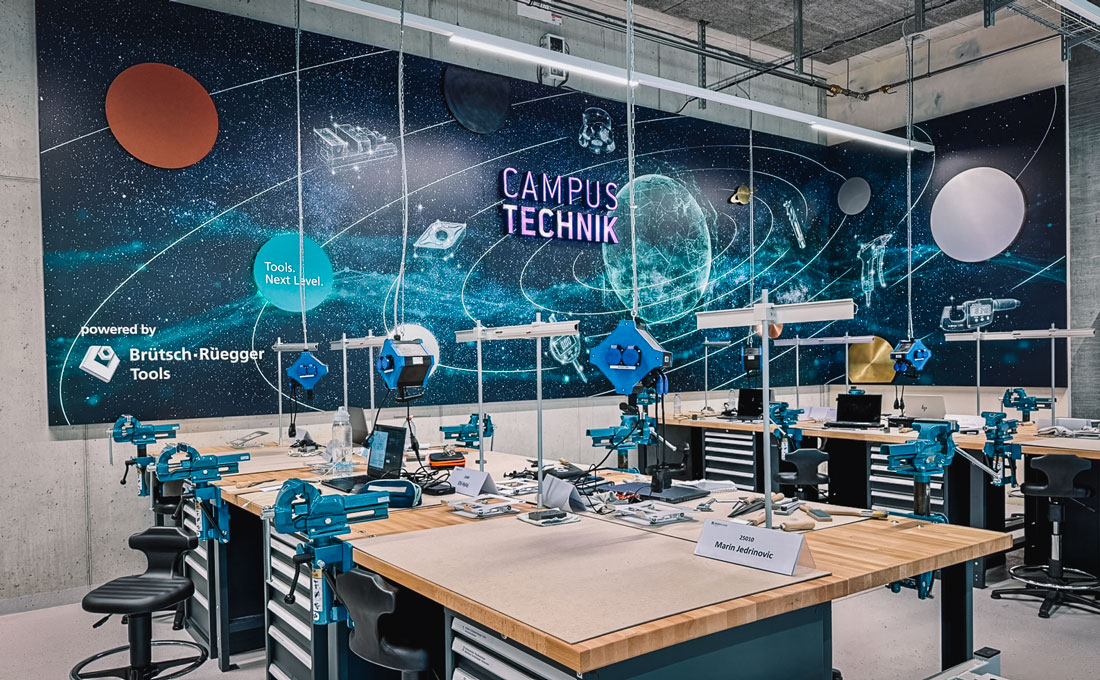 A look inside the modern workshop of Campus Technik – the new knowledge hub for mechanical and technical professions in Grenchen. (All images: Josua Lai)
Anyone entering Campus Technik senses it immediately: there is an almost electrifying energy in the air. It feels like a fresh start – full of drive and new visions. Here, just a short walk from Grenchen railway station, this is not simply another school. It is a strategic response to the needs of Swiss industry and STEM companies (known in German as MINT: mathematics, IT, natural sciences and technology). Swissmechanic’s Solothurn section has taken the lead in planning and implementation – and now also in day-to-day operations.
So what exactly is this organisation? As one of 15 regional sections of the national employers’, specialist and professional association, it represents the interests of the mechanical-technical and electrical engineering sectors in the canton of Solothurn. Across Switzerland, the name “Swissmechanic” stands for around 1,400 member companies with approximately 70,000 employees and 6,000 apprentices.
Part 2 of the series: “Lighthouse project for the STEM sector”
In the last issue of ToolNews, we introduced Campus Technik in Grenchen – a modern “hub of expertise” that is taking on the skills shortage with state-of-the-art infrastructure and innovative teaching methods. We saw where the future of the technology industry is taking shape. But a building is only a shell of concrete and glass. An ideas campus needs an engine to drive it forward – and people with the courage to leave old paths behind. In this second part of our series, we go behind the scenes at Campus Technik and put the spotlight on the people behind Swissmechanic Solothurn.
But the secretariat in Grenchen does not “just manage numbers”. Early on, the association realised that major goals are difficult to achieve alone: “Our member companies have understood that, as a strong association, we can achieve more – whether in economic policy, in the public image of the industry, or very concretely in education,” Swissmechanic says. Campus Technik is tangible proof of the strength of a community that does not wait for others to solve its problems.
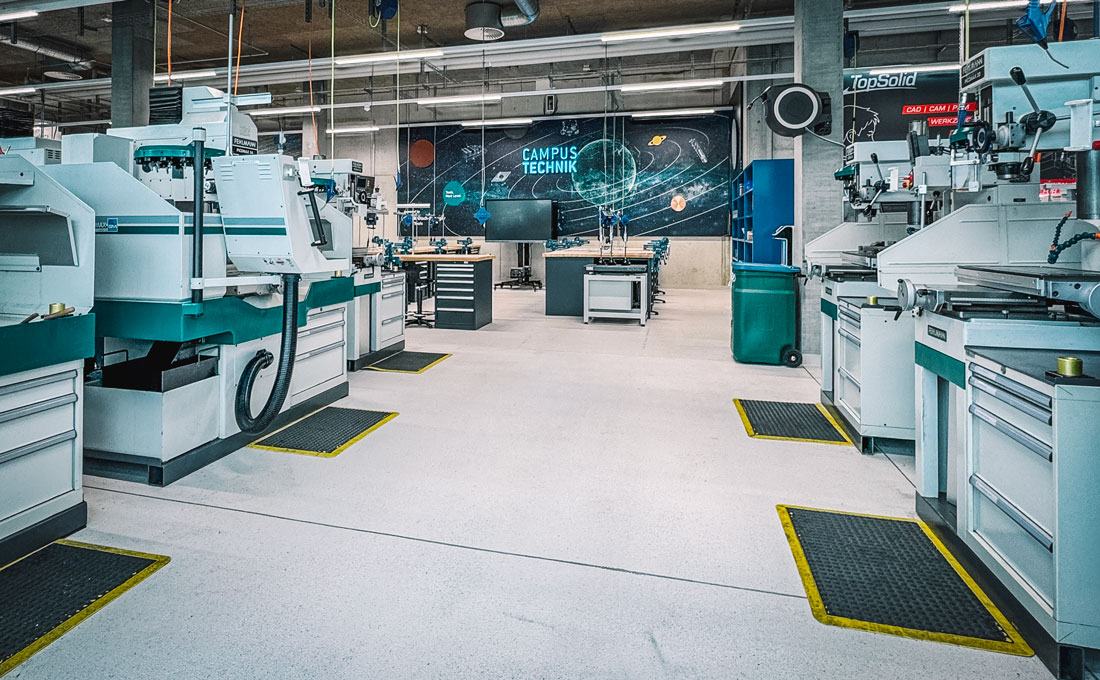 Better equipped than any apprentice workshop: at the training centre in Grenchen, apprentices have access to the latest technology.
Breaking out of the “destructive spiral”
Why would an employers’ association invest so heavily in building its own training centre – requiring investments of more than five million Swiss francs? To understand this, you have to talk to the people who poured their heart and soul into the project. One of them is Jan Sutter, Head of Training at Swissmechanic Solothurn and a member of the national association’s commission for basic vocational training.
For Sutter, the project is closely linked to his own career path: “Back then, I left the shop floor because I simply lacked development opportunities,” he explains. “I often felt I wasn’t reaching my full potential.” He describes his own training experience up to the age of 20 as sobering. “This can be done better,” he told himself – and switched sides to prove it.
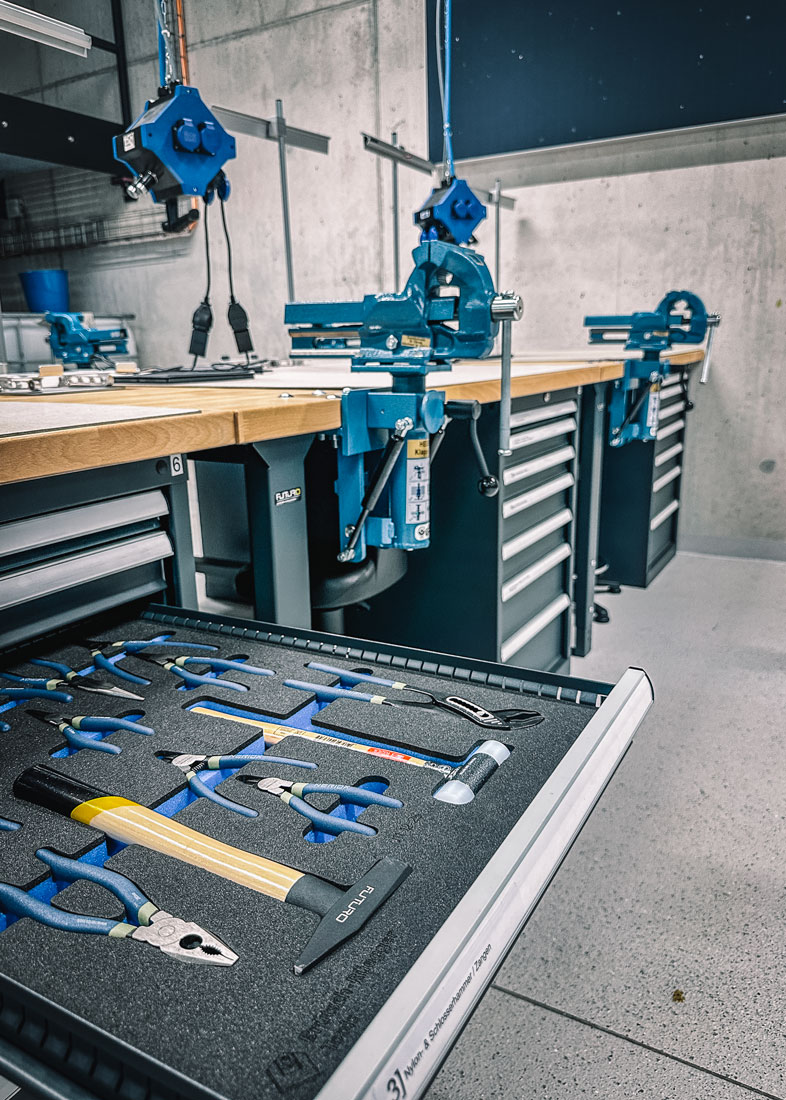 Everything has its place – learners are also taught order and precision.
Today, he is driven by the desire to close the gap between rapid technological progress in industry and often outdated training methods. He sees the sector caught in a dangerous dilemma and describes a “destructive spiral” that is becoming increasingly visible: the shortage of skilled workers leads to overload in companies. When skilled workers are missing, there is often too little time – or insufficient expertise – to provide high-quality support for apprentices. This frequently results in simple routine tasks and makes training less attractive – which further worsens the shortage.
“We often do young people an injustice”
For Sutter, Campus Technik is a key tool for breaking this vicious circle. It is about showing appreciation through investment: “We often do young people an injustice if we don’t provide them with the best tools. In a modern environment, we can achieve an enormous amount in a short time.” With Campus Technik, Swissmechanic wants to demonstrate that young talents can deliver results immediately and create real added value – if they are given the right environment.

The seamless “education value chain”
Campus Technik is therefore not about mere “cosmetic” improvements to the industry’s image, but about deep structural renewal. Enzo Armellino, Managing Director of Swissmechanic Solothurn and overall campus project manager, thinks in bigger contexts. For him, one key motivation was to overcome the fragmentation of the education landscape: “We wanted to unite the ‘education value chain’ in a single location and cover it seamlessly,” he explains. He describes four clear links – now reflected in the campus concept:
- focusMINT (Next generation): “We need to engage children and young people in a playful way and get them excited about technology long before they have to choose a career. If we wait until they are 16, it is often too late.”
- Basic education (Foundation): A vocational apprenticeship that keeps pace with technology and trains at the cutting edge.
- Further education (Progress): Lifelong learning, enabled by partners such as the Higher Technical College Mittelland (HFTM), which is based directly in the building.
- Application (Practice): Integrating companies directly in the building to ensure practical relevance and to exchange innovations.
“This gives the industry a stronger public presence,” Armellino summarises. By bringing these four areas together under one roof, synergies are created that tackle the root causes of the skills shortage instead of merely treating the symptoms. A place of lifelong learning has been created – where apprentices can meet executives in the cafeteria.

A convincing vision
However, good ideas and motivation alone do not create change. You also need the right partners and tools. Brütsch/Rüegger Tools provides both: “Attracting the right skilled workers for tomorrow, inspiring young people to pursue careers in mechanical engineering and manufacturing and providing them with high-quality training is a major challenge,” explains Olaf Sprich, Head of Sales and member of the management board of the leading tool partner. “This requires a modern and inspiring learning and working environment – and Swissmechanic Solothurn has created exactly that with Campus Technik.”
For Sprich and Brütsch/Rüegger Tools, it was only natural to support the project from the outset with equipment, tools and measuring instruments – as well as management and digitalisation solutions related to manufacturing. “It was clear to us: something great and unique is being created here, and we wanted to contribute to its success with enthusiasm and commitment.”
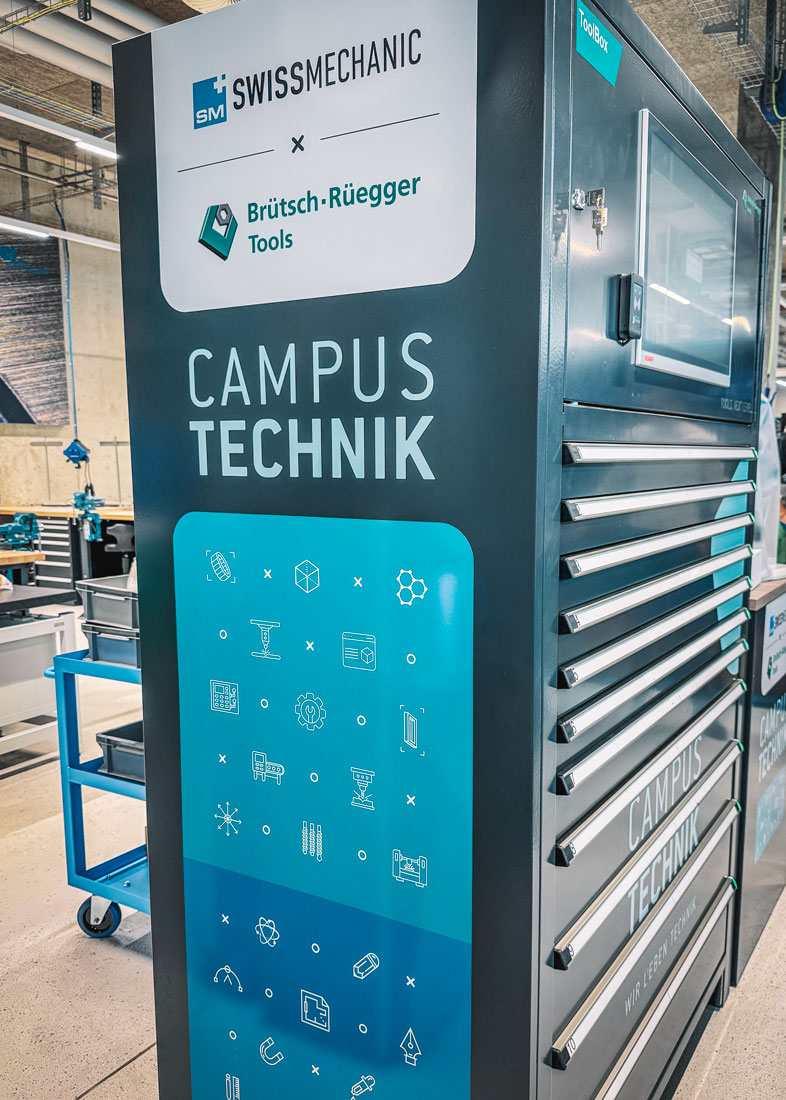 Strong partnership: Brütsch/Rüegger Tools has supported the vision of Campus Technik from day one.
Brütsch/Rüegger Tools’ vision and wish for Swissmechanic Solothurn is that, thanks to its state-of-the-art learning environment, high level of digitalisation and innovative methods of knowledge transfer, it will soon have a waiting list of interested apprentices – and that both training companies and apprentices will be queuing up to secure a place here. “That would be an important contribution to tackling the skills shortage sustainably,” Olaf Sprich emphasises.
Outlook: How do we learn today for the future?
Now you know the place and the strategists who made the vision of Campus Technik possible. You can see that Swissmechanic Solothurn is not only an administrator, but a shaper. But what does this revolutionary training look like in everyday practice? Why does a polymechanic learn differently here – and perhaps better – than elsewhere? In the third and final part of our series, we dive deep into the “engine room of pedagogy”. We show how basic vocational training is being reimagined at Campus Technik, what role partners such as Brütsch/Rüegger Tools play – and why this combination creates real leverage against the skills shortage.